


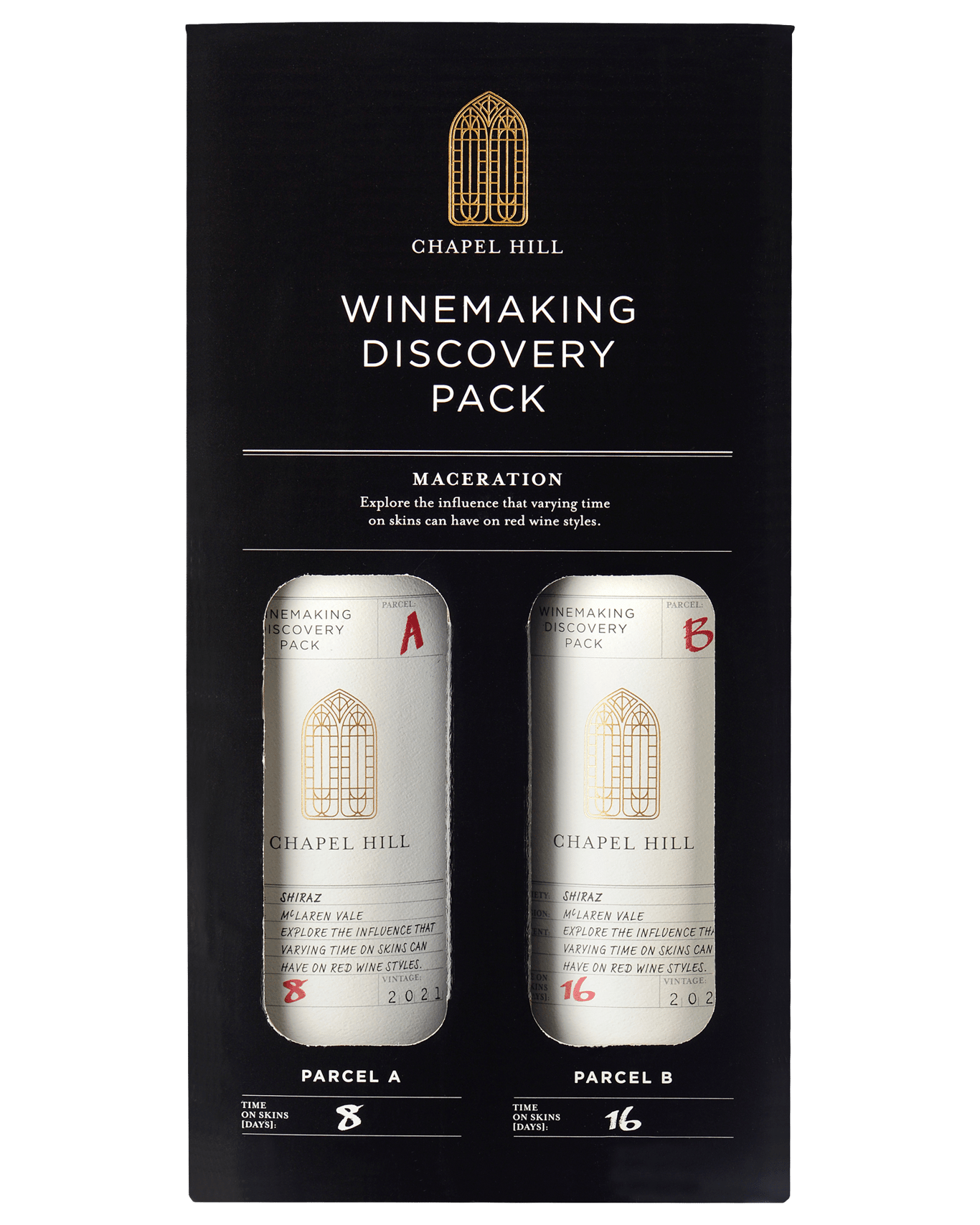
Two bottles of shiraz, identical in all ways but one: time on skins. Taste the difference for yourself.
Look, perhaps you’re someone who can take one blindfolded whiff of a wine and magically know what it is, where it came from, and what the winemaker’s third cousin had for breakfast – but that ain’t most of us. It’s incredibly hard to recognise the differences in wines without directly comparing them, so the best way to learn more about wine and how it’s made is by tasting it. You can read theory all you like, but it’s only practical, hands-on-glass experience that’ll really help you make sense of things. That’s where Chapel Hill come in.
In a true stroke of genius that I wish I had myself, Chapel Hill have released a twin pack of wines that homes in on one key aspect of the red wine making process – skin contact. Both bottles come filled with their best McLaren Vale shiraz, identical in all ways but one: bottle A spent 8 days on skins, while bottle B spent 16. Now it’s your turn to taste the difference.
The brainchild of Michael Fragos (Chapel Hill’s Head Winemaker), the pack is all about providing a tangible way to understand and appreciate winemaking, letting people in on the process that goes on behind winery doors. To help you get the most out of the pack, I sat down with Michael to learn all about the project and got him to take you and I through a guided tasting

Click image to shop
- Q.Lara: I love this idea so much. How did it come about?
Michael: We do winemaking trials every year in order to learn more about how different small changes might affect the finished wine. What happens if I do this? What happens if I take that away? Like any experiment, you want to make sure that you’re testing the right variable, so by making the wines identical except for that one thing, we can see what effect that specific change has on the wine – in this case, the time on skins.
When people come to the winery, we love taking them into the cellar and getting them to taste the wines straight out of the barrels. It really helps demystify the winemaking process. It illustrates how every one of the many steps influences what that final wine is going to smell and taste like. People might have a bit of an idea in their head about how it all works, but there’s always such a great response when they get to actually taste and compare the wines side by side – all this stuff that normally happens behind the scenes.
This project came about because I wanted to try and extend that same experience to people who can’t come and visit us. If you can’t come to Chapel Hill and try it straight from the barrel, this pack is the next best thing. And it’s not about saying which one’s better – we just encourage you to look for differences. Don’t feel that you have to say I prefer this one or that one for whatever reason, it’s just, can you see any differences in the wine and can we learn how the change in the winemaking process caused that difference?
- Q.Lara: Okay so what does ‘skin contact’ actually mean? We’re talking about grape skin right, not human?
Michael: Yes, grape skins. Wine grapes are actually considerably smaller than table grapes – people are surprised when they see them for the first time and see how small they are – and also their skins are incredibly thick compared to the type you find in the supermarket. If you peel open a red grape, you see that the colour of the juice is clear. But if you rub that skin between your fingers, you’ll see that beautiful red/purple colour slowly ooze out.
The magic of red wine is all in the skin. Everything that we love and adore about red wine – which is the colour, the flavour and the tannins (AKA the body) – it’s actually all in the skin, not the juice. So really the art and skill of red wine making is extracting that flavour, colour and tannin from the skins into the juice, because that’s what’s going to give your wine all the personality and character. That’s what happens during ‘time on skins’, or what we call ‘maceration’. Once you’ve separated the fermenting wine from the skin, you won’t be able to access (so to speak) any more flavour, colour and tannins. That’s why time on skins is so important and why we taste and analyse the wine daily to keep track of how it’s going.
- Q.Lara: I don’t know about you, but I’m definitely ready to get stuck into this tasting. First things first, do I need to do anything special? Do I need to decant or get myself a palate cleanser?
Michael: None of that. Just two clean glasses, pour a bit into each, and smell the wines before you taste them.
- Q.Lara: Hold on, before we start smelling things, let’s start with how the wines look. I might be hallucinating but to me wine A (8 days) looks, kind of, thicker? Denser, maybe? Whereas wine B (16 days) is a little more translucent around the edges. That is opposite to what I would have expected.
Michael: Good catch! I’m generalising a bit here, but science shows that the colour level of the wine peaks after 8 days. After that, some of the colour binds and precipitates out, so actually the longer you leave it on skins the colour will start to drop slightly.
It’s sometimes difficult to tell because McLaren Vale shiraz is so dark and black anyway that you usually don’t really notice any subtle colour difference, but with these two it’s actually fairly recognisable. Wine A has more of a deep black, purple tinge and wine B has a more red tone.
- Q.Lara: Wow! I was right. That’s unexpected. So how about aroma (or ‘nose’ as you wine guys call it)? I can smell… not a lot. They smell the same to me.
Michael: For a lot of the trials we do, they don’t change the nose a lot. It can be a very subtle difference. So I always encourage people, don’t get disillusioned when you smell the wines and you go, “Oh, they smell the same” – it’s really on the palate where these difference are more evidenced. And it’s not just taste in regards to flavour, it’s body, length and persistence, too.
Plus, what’s not different is just as useful to investigate as what is, so keep note of those things as well because it all helps you learn how this small change has affected (or not affected) the wine.
- Q.Lara: Roger that. Now the best part, the taste. *Takes a sip* Mmm, delicious. I love shiraz. It’s hard though because I can taste clear differences, but I don’t really have the lingo to explain it.
Michael: Use whatever words feel right. Think about the flavour intensity, the shape of the wine – is it round, is one sharper, is it cuddly? Focus on that instead of trying to pick out specific tasting notes or anything. It’s more about how it sits in your mouth – that’s where you really appreciate it.
So with these, Wine B (16 days) is a little more opulent and round. It’s a bit more generous, it’s richer, but it’s actually softer and a lot more balanced. And this is where that science gets interesting again. People think that because something is on skins longer it’s extracting more tannins so it’s going to be more full bodied and firmer in your mouth, but that’s not the case.
A young wine has a lot of (what we call) small tannins. So again, after that initial 8 days, those tannins start to bind together thanks to contact with oxygen. And as these tannin molecules get bigger, they get softer. Now that’s all rather scientific, but what we can learn is that even though we extracted more tannin, the fact that they start to bind together after those 8 days means we end up with a softer, rounder wine.
- Q.Lara: Fascinating! I fell for your trap. I expected the complete opposite.
Michael: I think that’ll surprise a lot of people here. They’ll think longer on skins means more intensity, but because of that changing of the tannins it’s actually softer, rounder and probably more approachable than the wine A.
If you try the first wine again, you might notice that the tannins now feel a bit grippier, a bit firmer, and you can really appreciate how round and soft that second wine actually is.
- Q.Lara: Definitely. A is like one big punch of flavour, whereas B is longer, a bit more complex. Like I get to actually taste the different levels and layers. A is a bit more one-note. Does that make any sense?
Michael: Yeah! A, as you might expect, is a little bit simpler. Versus B, with that additional time on skins the wine’s just increased in complexity, in tannin, it’s become more decadent. A has more lifted fruit flavour, it’s a bit more boisterous, you get those aniseed and blueberry flavours. The tannin that’s there is quite linear, with a little bit of grip, it’s got some edges, and you feel it mainly on the edges of your tongue.
Versus the second wine where you don’t have as much of that lifted fruit character. It’s gentler on the flavour, but instead you’ve got these beautiful, mouth-coating, round, soft tannins. Even after you swallow, you’ve still got that puckering tannin quality all over the mouth. It’s quite salivating!
- Q.Lara: What would happen if you left it on for double the time again – 32 days?
Michael: Every parcel of grapes can react differently. There’s the potential that the wine could continue to get softer and more layered. You could get to a point where the wine is too soft and developed, which you don’t want.
The other thing that can happen is, there are tannins in the seeds and these are quite bitter, so the longer you leave something on skins, the more chance there is that you’re going to extract some of those harsh, bitter tannins from the seeds. So in addition to having a softer wine, you’ll also have this jarring jolt at the back of your palate from that bitterness. So this has to be managed carefully and the wine needs to be tasted regularly when it’s still on skins.
- Q.Lara: What a delicious way to learn more about wine. But skin contact is obviously just one tiny part of the winemaking process. Do you have plans to showcase any others in similar packs down the track?
Michael: Yes! Definitely. Our sister winery Isabel Estate are working on a comparison pack of their own, but rather than looking at time on skins in shiraz they’ll be evaluating wild yeast fermentation in their sauvignon blanc.
We’ve also got another comparison pack coming ourselves, from our 2022 vintage. We’ll be maturing the same wine (McLaren Vale shiraz) in both new and old French oak to really illustrate the impact the age of the oak has on the wine. You often hear people say “oh this is oaky”, but it can be hard to understand what that means without a tangible example, so this will be a great opportunity to recognise and understand the profound characteristics of new oak versus old.
- Q.Lara: Well that’s good news. I can’t wait. In the meantime, do you have any last words of wisdom for our fellow wine explorers?
Michael: Once you’ve tasted the wines and written down all your notes, it might be a fun little exercise to do a blind test, retaste the wines and see if you can pick which one is which. And if not, it doesn’t matter. It’s all just a bit of fun and a different way to enjoy wine.


%20(1)?$dans-daily-web-image$&hei=900)
?$dans-daily-web-image$&fmt=png-alpha&wid=800)