

It’s a matter of monastic life.
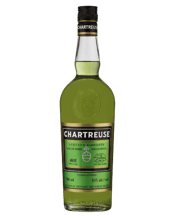
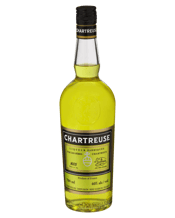
For more than two centuries, Chartreuse has been made exclusively by the Carthusian monks of Grande Chartreuse Monastery nestled in the French Alps. They are the only ones with the 130-ingredient recipe that produces the Wizard-of-Oz-green herbal liqueur (and its yellow sibling). In fact, only two of the monks in the monastery actually know the full recipe, but that only adds to the level of exclusivity associated with this liqueur.
The monastery turns out 1.6 million bottles of Chartreuse a year, which was fine when it was the well-kept secret of industry people, dads, and flamboyant cocktail makers. But since the mid-2000s, when craft cocktails started to trend, Chartreuse has become a regular order at any venue with a solid cocktail list. Fast forward to 2020 and a pandemic where home mixology was a cocktail fan’s only option, and Chartreuse sales doubled worldwide. This boom in demand was not actually welcomed by the monks, who had quietly decided in 2019 to cap their production. This was an environmentally conscious move, yes, but also designed to give them space to focus on their main job: solitude and prayer. Read: we are monks!
Ergo, the amount of green and the subtler yellow Chartreuse being made isn’t changing, but more people want it, and people who know it’s harder to get may start stocking up when they can, which could make it even harder to get. So, when Chartreuse is nowhere to be found, we have some ideas for what to do instead.
Firstly, let's put it out there that Green Chartreuse is currently in stock at Dan Murphy’s, so needing a sub for its unique herbal-meets-floral-meets-spice flavour isn’t necessary. But you know what they say – fail to plan and you plan to fail. To be totally transparent, this is a liqueur that’s extremely difficult to dupe, particularly in Australia as opposed to the US, where there are some good local options. Nevertheless, here are three viable replacements.
1. Génépi
We think that, far and away, the closest Green Chartreuse mimic is fellow French herbaceous liqueur Génépi. It shares the same flavour profile and is even made in the same region, however, in Australia, it can be almost harder to find than Chartreuse, so let’s keep moving.
2. Izarra Vert
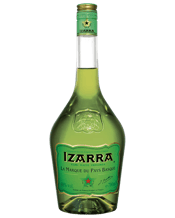
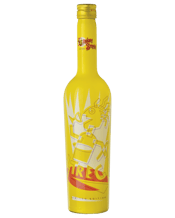
Green, like Chartreuse. French, like Chartreuse. Hyper herbaceous, like Chartreuse. Izarra Vert is like the many botanical liqueurs you find anywhere in Europe with a mountain. These alpine sips are always full of flavour, but they have their differences. Izarra has a long history in French Basque Country. Technically, it’s armagnac flavoured with 16 botanicals including typical peppermint and almonds, and less typical walnut and celery. The brand has both a green and yellow version, and it has many of the Chartreuse hallmarks, the yellow in particular is a very close dupe. The green differs with a lower alcohol content (40% compared to Chartreuse’s 55%) and its flavour is more peppery and piney, but still, a very decent sub.
3. Absinthe, Sambuca and Fernet Branca
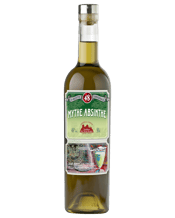
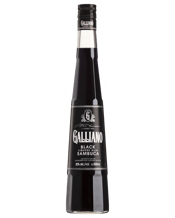
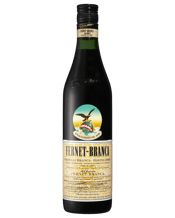
Undoubtedly, none of these taste quite like Chartreuse, but in a pinch, they are each an effective swap for a cocktail recipe that calls for it; just know they’ll change up the flavour of your mix, but not in a bad way. Absinthe has the high ABV of Chartreuse – it can actually be as high as 80% – and it also has the herbaceous and floral base. Chiefly, they share the key ingredient wormwood. The difference is that absinthe’s grassy notes are dominated by its licorice flavour. Try it as a switch in a Last Word where the tequila tames the absinthe as it would the Chartreuse, and is complemented by the lime and maraschino cherry. Sambuca is a sweeter liqueur, but it has a strong flavour profile that’s anise-forward like absinthe, which makes it a good Chartreuse sub. It plays well with pineapple, so it’s a suitable switch in something like a Chartreuse Swizzle. Finally, Fernet Branca, the most famous of the fernet liquor brands. This is another one known for sitting unused in many a bar cart (it shouldn’t, by the way – it’s delicious) and popular with world-class mixologists. It is an Italian liqueur that has a menthol taste, similar to that of Chartreuse’s peppermint. It has less sweetness than Chartreuse, so adjust it in your mixes accordingly. It would be best subbed in something creamy or sweet, like a Tipperary.
Unlike Green, Yellow Chartreuse is much easier to find a close match for. It’s mellower and sweeter, and while those complex herbs and spices are still there, it’s the notes of honey and saffron that sing loud. Here are our top three substitutes for Yellow Chartreuse.
1. Strega
This is your best option. It’s essentially the Italian version of Yellow Chartreuse and even used as a sub in some cocktail bars. It’s slightly sweet but mostly savoury, semi-viscous, and has a bold, complex flavour with strong minty or coniferous notes and, importantly, it’s bright yellow. This is because saffron is the key ingredient in Strega, so you don’t even have to compromise on the colour of your drink. It can easily play the starring role in a Yellow Chartreuse-heroed drink, like a Naked & Famous. Think of it as a very good understudy.
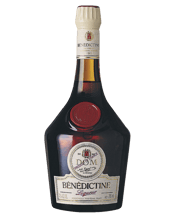
Like Chartreuse, this is made by French monks, and has been for hundreds of years, so it has that holy thing going for it. It’s all herbs and spices, albeit 27 rather than 130, and has a 40% ABV so it’s on par with strength. It has a brandy base and big flavour but overall it is a sweeter, simpler liqueur. It has a bit more vanilla and spice, but it makes a very sufficient swap, particularly in a spirit-forward cocktail like a Yellow Negroni or a Bijou.
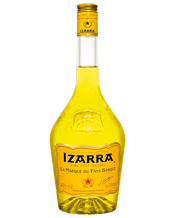
3. Izarra Jaune
A match in terms of its ABV, French origins, yellow hue and botanicals in the mix, Izarra Jaune is a better match for Yellow Chartreuse than the green counterparts. The smoky, candied spice flavour of the armagnac base is more noticeable in the Jaune, and all the more delicious for it. It’s a satisfactory swap for any drink that calls for Yellow Chartreuse, particularly one that has a lot of other elements, and you really need this element to bring the herbal punch – for example, the Mujer Verde.