

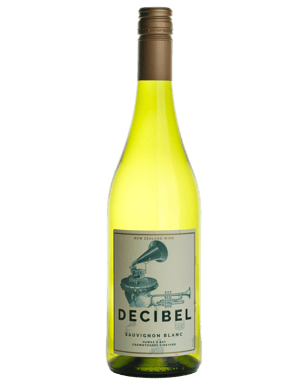
DecibelHawkes Bay Sauv Blanc 2023
 Dry, Light Bodied style of Sauvignon Blanc
 Pairs well with Seafood
About this product
Dry, Light Bodied style of Sauvignon BlancPairs well with SeafoodThe nose shows lemongrass, kaffir lime and red grapefruit… Hints of crisp nectarine, rich nougat and citrus rind evolve on the back of the nose. The palate begins fresh with bright peachy fruit, pineapple and is plusher than expected once it hits the midpalate. The finish has a driving acidity that is cuddled by hints of fruit sweetness, leaving the mouth watering for another sip
Winemakers Notes
I discovered HBSB my first weekend here in HB in the summer of 2008 and thought right away that I wanted to make one of my own. The soft, complex, more tropical style appeals more to me than the styles grown to the south of HB. So we work on lots of lees stirring and accentuating those fleshy, rich notes. While there’s no doubt it’s a Kiwi SB, it’s also uniquely Hawke’s Bay and I love that.
Vineyard
Hawke’s Bay lies on the East Coast of the North Island of New Zealand. The region enjoys dry summers with moderate, cool nights. This wine reflects a single vineyard Sauvignon Blanc which was grown inland on the elevated terraces of the Crownthorpe sub-region of Hawke’s Bay. This appellation enjoys long, strong sunlight hours but is slightly cooler than the coastal plains of Hawke’s Bay, making it most suitable for growing Sauvignon Blanc. The 2021-22 season was a relatively warm with above average rainfall in the spring. Crop loads and options on the vine were also above average. The growing season was fine until a cold spell in February followed by some rainfall throughout March and April. However, Sauvignon Blanc remained resilient, especially up in the Crownthrope region, where we were able to let the fruit hang out to achieve the ripeness and flavour development needed to produce this unique style.
Winemaking
The fruit was picked over 3 days in early April then de-stemmed and crushed. The juice was settled and fermented in stainless steel tanks using two different yeasts in co-fermentation. Frequent stirring was done throughout fermentation and post fermentation allowing the solids to flesh out the palate. The wine was then cold settled and stabilized before bottling under screw-cap to maintain the bright fruit and aromatics gained from the young New Zealand soils and phenomenal UV light.
Winemakers Notes
I discovered HBSB my first weekend here in HB in the summer of 2008 and thought right away that I wanted to make one of my own. The soft, complex, more tropical style appeals more to me than the styles grown to the south of HB. So we work on lots of lees stirring and accentuating those fleshy, rich notes. While there’s no doubt it’s a Kiwi SB, it’s also uniquely Hawke’s Bay and I love that.
Vineyard
Hawke’s Bay lies on the East Coast of the North Island of New Zealand. The region enjoys dry summers with moderate, cool nights. This wine reflects a single vineyard Sauvignon Blanc which was grown inland on the elevated terraces of the Crownthorpe sub-region of Hawke’s Bay. This appellation enjoys long, strong sunlight hours but is slightly cooler than the coastal plains of Hawke’s Bay, making it most suitable for growing Sauvignon Blanc. The 2021-22 season was a relatively warm with above average rainfall in the spring. Crop loads and options on the vine were also above average. The growing season was fine until a cold spell in February followed by some rainfall throughout March and April. However, Sauvignon Blanc remained resilient, especially up in the Crownthrope region, where we were able to let the fruit hang out to achieve the ripeness and flavour development needed to produce this unique style.
Winemaking
The fruit was picked over 3 days in early April then de-stemmed and crushed. The juice was settled and fermented in stainless steel tanks using two different yeasts in co-fermentation. Frequent stirring was done throughout fermentation and post fermentation allowing the solids to flesh out the palate. The wine was then cold settled and stabilized before bottling under screw-cap to maintain the bright fruit and aromatics gained from the young New Zealand soils and phenomenal UV light.
The nose shows lemongrass, kaffir lime and red grapefruit… Hints of crisp nectarine, rich nougat and citrus rind evolve on the back of the nose. The palate begins fresh with bright peachy fruit, pineapple and is plusher than expected once it hits the midpalate. The finish has a driving acidity that is cuddled by hints of fruit sweetness, leaving the mouth watering for another sip
Winemakers Notes
I discovered HBSB my first weekend here in HB in the summer of 2008 and thought right away that I wanted to make one of my own. The soft, complex, more tropical style appeals more to me than the styles grown to the south of HB. So we work on lots of lees stirring and accentuating those fleshy, rich notes. While there’s no doubt it’s a Kiwi SB, it’s also uniquely Hawke’s Bay and I love that.
Vineyard
Hawke’s Bay lies on the East Coast of the North Island of New Zealand. The region enjoys dry summers with moderate, cool nights. This wine reflects a single vineyard Sauvignon Blanc which was grown inland on the elevated terraces of the Crownthorpe sub-region of Hawke’s Bay. This appellation enjoys long, strong sunlight hours but is slightly cooler than the coastal plains of Hawke’s Bay, making it most suitable for growing Sauvignon Blanc. The 2021-22 season was a relatively warm with above average rainfall in the spring. Crop loads and options on the vine were also above average. The growing season was fine until a cold spell in February followed by some rainfall throughout March and April. However, Sauvignon Blanc remained resilient, especially up in the Crownthrope region, where we were able to let the fruit hang out to achieve the ripeness and flavour development needed to produce this unique style.
Winemaking
The fruit was picked over 3 days in early April then de-stemmed and crushed. The juice was settled and fermented in stainless steel tanks using two different yeasts in co-fermentation. Frequent stirring was done throughout fermentation and post fermentation allowing the solids to flesh out the palate. The wine was then cold settled and stabilized before bottling under screw-cap to maintain the bright fruit and aromatics gained from the young New Zealand soils and phenomenal UV light.
Winemakers Notes
I discovered HBSB my first weekend here in HB in the summer of 2008 and thought right away that I wanted to make one of my own. The soft, complex, more tropical style appeals more to me than the styles grown to the south of HB. So we work on lots of lees stirring and accentuating those fleshy, rich notes. While there’s no doubt it’s a Kiwi SB, it’s also uniquely Hawke’s Bay and I love that.
Vineyard
Hawke’s Bay lies on the East Coast of the North Island of New Zealand. The region enjoys dry summers with moderate, cool nights. This wine reflects a single vineyard Sauvignon Blanc which was grown inland on the elevated terraces of the Crownthorpe sub-region of Hawke’s Bay. This appellation enjoys long, strong sunlight hours but is slightly cooler than the coastal plains of Hawke’s Bay, making it most suitable for growing Sauvignon Blanc. The 2021-22 season was a relatively warm with above average rainfall in the spring. Crop loads and options on the vine were also above average. The growing season was fine until a cold spell in February followed by some rainfall throughout March and April. However, Sauvignon Blanc remained resilient, especially up in the Crownthrope region, where we were able to let the fruit hang out to achieve the ripeness and flavour development needed to produce this unique style.
Winemaking
The fruit was picked over 3 days in early April then de-stemmed and crushed. The juice was settled and fermented in stainless steel tanks using two different yeasts in co-fermentation. Frequent stirring was done throughout fermentation and post fermentation allowing the solids to flesh out the palate. The wine was then cold settled and stabilized before bottling under screw-cap to maintain the bright fruit and aromatics gained from the young New Zealand soils and phenomenal UV light.

Light bodied white wines have a water-light mouthfeel. Often very pale to light colour.

Dry wines have no trace of sweetness at all.
- TypeSauvignon Blanc
- Size750ML
- Current Vintage2023
- Standard Drinks7.7
- Alcohol Volume13%
- CountryNew Zealand
- Brand NameDecibel
- Wine MakerDan Brennan
- Food MatchSeafood
- ClosureScrew Cap
- Wine SweetnessDry
- Wine BodyLight Bodied
- Organictrue
Ratings and Reviews

Be the first to write a review.