

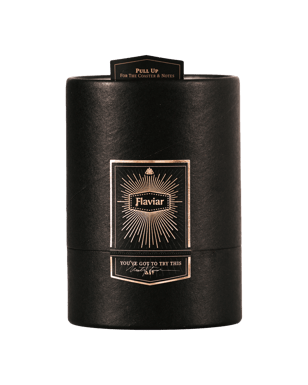
FlaviarQueen's Quintet Tasting Box 135mL
About this product
The sooner the tea's out the way, the sooner we can bring out the Gin.
People have been mixing juniper with alcohol since 70 AD — which means it's possible Marcus Aurelius and Hadrian tippled on proto Gin, although the doc that invented it said it fights chest illnesses. Fast-forward to the 16th century when the Water of Fruits (juniper-forward Spirit) was in vogue with the Brits and when Genever, another juniper-based potion, was enjoyed in the Netherlands. Officially, they consumed it to alleviate kidney troubles. When William of Orange sat on the British throne, the Water of Fruits took on the Dutch moniker, and the love for juniper doubled.
In the 18th century, the era of the Sun King and the Industrial Revolution, the Age of Gin Craze arrived. After a couple of law changes, anyone could make their own Gin, and at a point, one in every four houses in London was distilling. Now, that sounds grand and all, but most of them didn't know what they were doing, and Gin was often toxic (flavoring it with turpentine is less than ideal). New laws came, and Gin production became more controlled and less lethal.
Old Tom Gin was conjured in 1813, Aeneas Coffey invented the revolutionary column still, distillers were betting on higher quality and more elegant flavor profiles, while consumers shifted away from syrupy drinks to more refined tipples. Come Fin de siècle, London Dry Gin was the #1 style of Gin for sipping and mixing.
Now, London Dry Gin doesn't have to be made in London, but there are rules to be followed. The EU law says all Gins must mostly contain juniper, and the ABV should be at least 37.5%. None of that weak stuff, please. To put a Gin in the London Dry category, the base Spirit must be completely neutral with 96% ABV. All flavors must be added during the distillation and can only be natural plants. The only thing you may add is water and a smidge of sugar. So, in other words: London Dry Gins contain only distilled botanicals and have no added flavors once they're distilled. Simple, right?
This themed Tasting Box celebrates the precise art of the London Dry Gin, presenting you with five wildly different expressions. Broken Bones London Dry Gin is incredibly floral (10 carefully selected botanicals), comes from Central Europe, and just can't stop winning awards - even got the title "Best in Europe" in 2020! The second delight in the box is One Gin Classic, a bold and savory gem betting on fresh sage.
It won an IWSC Gold Award and is heavenly in a naked Dry Martini. Then there's Dingle Original Gin, a unique, inventive twist on the traditional category. What's unique about it? Well, 2019 World's Best London Dry Gin uses botanicals foraged in the County Kerry, including rowan berry, fuchsia, bog myrtle, hawthorn, and heather give.
Beautiful and proudly Irish! No.3 London Dry Gin bases its glorious flavor profile on three fruits (Italian juniper, Spanish orange peels, and grapefruit) and three spices (angelica, Moroccan coriander, and spicy cardamom). Wrap your Gin tasting party with the 2017 Flaviar Community Award winner, Sipsmith London Dry Gin! Using ten carefully-selected botanicals, they source the finest English Barley and the exceptionally pure water of Lydwell spring. It's just so unbelievably smooth.
People have been mixing juniper with alcohol since 70 AD — which means it's possible Marcus Aurelius and Hadrian tippled on proto Gin, although the doc that invented it said it fights chest illnesses. Fast-forward to the 16th century when the Water of Fruits (juniper-forward Spirit) was in vogue with the Brits and when Genever, another juniper-based potion, was enjoyed in the Netherlands. Officially, they consumed it to alleviate kidney troubles. When William of Orange sat on the British throne, the Water of Fruits took on the Dutch moniker, and the love for juniper doubled.
In the 18th century, the era of the Sun King and the Industrial Revolution, the Age of Gin Craze arrived. After a couple of law changes, anyone could make their own Gin, and at a point, one in every four houses in London was distilling. Now, that sounds grand and all, but most of them didn't know what they were doing, and Gin was often toxic (flavoring it with turpentine is less than ideal). New laws came, and Gin production became more controlled and less lethal.
Old Tom Gin was conjured in 1813, Aeneas Coffey invented the revolutionary column still, distillers were betting on higher quality and more elegant flavor profiles, while consumers shifted away from syrupy drinks to more refined tipples. Come Fin de siècle, London Dry Gin was the #1 style of Gin for sipping and mixing.
Now, London Dry Gin doesn't have to be made in London, but there are rules to be followed. The EU law says all Gins must mostly contain juniper, and the ABV should be at least 37.5%. None of that weak stuff, please. To put a Gin in the London Dry category, the base Spirit must be completely neutral with 96% ABV. All flavors must be added during the distillation and can only be natural plants. The only thing you may add is water and a smidge of sugar. So, in other words: London Dry Gins contain only distilled botanicals and have no added flavors once they're distilled. Simple, right?
This themed Tasting Box celebrates the precise art of the London Dry Gin, presenting you with five wildly different expressions. Broken Bones London Dry Gin is incredibly floral (10 carefully selected botanicals), comes from Central Europe, and just can't stop winning awards - even got the title "Best in Europe" in 2020! The second delight in the box is One Gin Classic, a bold and savory gem betting on fresh sage.
It won an IWSC Gold Award and is heavenly in a naked Dry Martini. Then there's Dingle Original Gin, a unique, inventive twist on the traditional category. What's unique about it? Well, 2019 World's Best London Dry Gin uses botanicals foraged in the County Kerry, including rowan berry, fuchsia, bog myrtle, hawthorn, and heather give.
Beautiful and proudly Irish! No.3 London Dry Gin bases its glorious flavor profile on three fruits (Italian juniper, Spanish orange peels, and grapefruit) and three spices (angelica, Moroccan coriander, and spicy cardamom). Wrap your Gin tasting party with the 2017 Flaviar Community Award winner, Sipsmith London Dry Gin! Using ten carefully-selected botanicals, they source the finest English Barley and the exceptionally pure water of Lydwell spring. It's just so unbelievably smooth.
The sooner the tea's out the way, the sooner we can bring out the Gin.
People have been mixing juniper with alcohol since 70 AD — which means it's possible Marcus Aurelius and Hadrian tippled on proto Gin, although the doc that invented it said it fights chest illnesses. Fast-forward to the 16th century when the Water of Fruits (juniper-forward Spirit) was in vogue with the Brits and when Genever, another juniper-based potion, was enjoyed in the Netherlands. Officially, they consumed it to alleviate kidney troubles. When William of Orange sat on the British throne, the Water of Fruits took on the Dutch moniker, and the love for juniper doubled.
In the 18th century, the era of the Sun King and the Industrial Revolution, the Age of Gin Craze arrived. After a couple of law changes, anyone could make their own Gin, and at a point, one in every four houses in London was distilling. Now, that sounds grand and all, but most of them didn't know what they were doing, and Gin was often toxic (flavoring it with turpentine is less than ideal). New laws came, and Gin production became more controlled and less lethal.
Old Tom Gin was conjured in 1813, Aeneas Coffey invented the revolutionary column still, distillers were betting on higher quality and more elegant flavor profiles, while consumers shifted away from syrupy drinks to more refined tipples. Come Fin de siècle, London Dry Gin was the #1 style of Gin for sipping and mixing.
Now, London Dry Gin doesn't have to be made in London, but there are rules to be followed. The EU law says all Gins must mostly contain juniper, and the ABV should be at least 37.5%. None of that weak stuff, please. To put a Gin in the London Dry category, the base Spirit must be completely neutral with 96% ABV. All flavors must be added during the distillation and can only be natural plants. The only thing you may add is water and a smidge of sugar. So, in other words: London Dry Gins contain only distilled botanicals and have no added flavors once they're distilled. Simple, right?
This themed Tasting Box celebrates the precise art of the London Dry Gin, presenting you with five wildly different expressions. Broken Bones London Dry Gin is incredibly floral (10 carefully selected botanicals), comes from Central Europe, and just can't stop winning awards - even got the title "Best in Europe" in 2020! The second delight in the box is One Gin Classic, a bold and savory gem betting on fresh sage.
It won an IWSC Gold Award and is heavenly in a naked Dry Martini. Then there's Dingle Original Gin, a unique, inventive twist on the traditional category. What's unique about it? Well, 2019 World's Best London Dry Gin uses botanicals foraged in the County Kerry, including rowan berry, fuchsia, bog myrtle, hawthorn, and heather give.
Beautiful and proudly Irish! No.3 London Dry Gin bases its glorious flavor profile on three fruits (Italian juniper, Spanish orange peels, and grapefruit) and three spices (angelica, Moroccan coriander, and spicy cardamom). Wrap your Gin tasting party with the 2017 Flaviar Community Award winner, Sipsmith London Dry Gin! Using ten carefully-selected botanicals, they source the finest English Barley and the exceptionally pure water of Lydwell spring. It's just so unbelievably smooth.
People have been mixing juniper with alcohol since 70 AD — which means it's possible Marcus Aurelius and Hadrian tippled on proto Gin, although the doc that invented it said it fights chest illnesses. Fast-forward to the 16th century when the Water of Fruits (juniper-forward Spirit) was in vogue with the Brits and when Genever, another juniper-based potion, was enjoyed in the Netherlands. Officially, they consumed it to alleviate kidney troubles. When William of Orange sat on the British throne, the Water of Fruits took on the Dutch moniker, and the love for juniper doubled.
In the 18th century, the era of the Sun King and the Industrial Revolution, the Age of Gin Craze arrived. After a couple of law changes, anyone could make their own Gin, and at a point, one in every four houses in London was distilling. Now, that sounds grand and all, but most of them didn't know what they were doing, and Gin was often toxic (flavoring it with turpentine is less than ideal). New laws came, and Gin production became more controlled and less lethal.
Old Tom Gin was conjured in 1813, Aeneas Coffey invented the revolutionary column still, distillers were betting on higher quality and more elegant flavor profiles, while consumers shifted away from syrupy drinks to more refined tipples. Come Fin de siècle, London Dry Gin was the #1 style of Gin for sipping and mixing.
Now, London Dry Gin doesn't have to be made in London, but there are rules to be followed. The EU law says all Gins must mostly contain juniper, and the ABV should be at least 37.5%. None of that weak stuff, please. To put a Gin in the London Dry category, the base Spirit must be completely neutral with 96% ABV. All flavors must be added during the distillation and can only be natural plants. The only thing you may add is water and a smidge of sugar. So, in other words: London Dry Gins contain only distilled botanicals and have no added flavors once they're distilled. Simple, right?
This themed Tasting Box celebrates the precise art of the London Dry Gin, presenting you with five wildly different expressions. Broken Bones London Dry Gin is incredibly floral (10 carefully selected botanicals), comes from Central Europe, and just can't stop winning awards - even got the title "Best in Europe" in 2020! The second delight in the box is One Gin Classic, a bold and savory gem betting on fresh sage.
It won an IWSC Gold Award and is heavenly in a naked Dry Martini. Then there's Dingle Original Gin, a unique, inventive twist on the traditional category. What's unique about it? Well, 2019 World's Best London Dry Gin uses botanicals foraged in the County Kerry, including rowan berry, fuchsia, bog myrtle, hawthorn, and heather give.
Beautiful and proudly Irish! No.3 London Dry Gin bases its glorious flavor profile on three fruits (Italian juniper, Spanish orange peels, and grapefruit) and three spices (angelica, Moroccan coriander, and spicy cardamom). Wrap your Gin tasting party with the 2017 Flaviar Community Award winner, Sipsmith London Dry Gin! Using ten carefully-selected botanicals, they source the finest English Barley and the exceptionally pure water of Lydwell spring. It's just so unbelievably smooth.
- Size135ML
- Standard Drinks4.8
- Alcohol Volume45%
- CountryUnited States
- Brand NameFlaviar
- ClosureCork
Ratings and Reviews

Be the first to write a review.